McIntosh Marketing Blog

Pay Per Click (PPC) Defined

This is an advertising method where an advertiser pays a certain amount of money every time someone clicks on one of their ads, and therefore is taken to their website.  This method was popularized by Google’s “Adwords” program.  And while there are many other PPC programs available, Adwords is still the largest, most popular and most effective.

The way Adwords works is, you bid on certain keywords related to your website or business.  You say, “I am willing to pay this much money every time someone clicks on my ad”.  That amount varies dramatically based on your market and competition. It can be as little as 1 cent, or as much as 40 dollars or more.  Then, when someone searches for any of the keywords you have bid on, Google does a mini auction, determining who’s ad will show in what position.  The main things they look at when they do this auction is the keyword’s relevance to your website, the quality of your website itself, the quality and performance of your ad, and of course, your bid price.  Once the auction is completed, Google then assigns the different ads to the different positions and displays them.  Here’s the important thing though, you don’t pay what you bid – you pay based on the people below you’s bid.  Because of these other factors, like the quality of your website, past performance and keyword relevance, you can actually be paying much less than the people below you and show up higher than them!

Not all PPC programs work this way, but many of the most popular ones do.  There are many good reasons to not only use Google’s adwords, but use the other programs as well.  You can often get better traffic for less from these other programs.  But as far as sheer quantity, Adwords is the best.
Read more »

Tags: , , ,

Ten AdWords Questions To Make You More Money

AdWords is deceptive.  Where as programming a website appears complicated and a subject most people would never attempt, AdWords seems approachable.  But in programming, you learn from your mistakes and never lose a penny.  AdWords mistakes, on the other hand, can cost thousands of dollars and can incur penalties that can never be overcome.

I find myself asking the same AdWords questions to every potential client.  In the hopes of improving everyone’s campaigns, I will list my general questions here, along with the typical answers I receive.

1.  Are you happy with your results?  Is your campaign profitable?

Normal Answer:  “Not really – no.” I haven’t spoken to a person yet that was happy with their results, although I have seen profitable yet wasteful ones. I have seen one client throwing away thousands of dollars a week.  That account had so many things wrong that I just told them to turn their account off.

2.  Who set up your AdWords account?

Normal Answer:  “I/We did.  Why?”

If the client set it up themselves, that tells me that there are most likely penalties or mistakes that need to be fixed.  It also gives me an idea of their skill level and what the rest of the answers to my questionnaire would be.

3.  What is your quality score?

Normal Answer:  “What is ‘quality score’?”

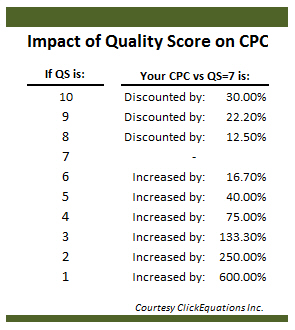
(This is a number from 1 to 10 that measures the “quality” of a given ad)

Most clients don’t know where this information is since Google hides this information from view.

If the quality score is below 7/10,  you are incurring penalties and don’t even realize it (see chart)

4.  Where are you sending people that click on your ads?

Normal Answer:  “Our home page”. The correct answer, of course, is a dedicated landing page for the specific keyword group.

If you sell computer supplies, you may have a keyword group called “keyboards”.  You would then want to send someone to the web page:  http://www.mydomain/keyboard which shows them all your keyboards, NOT to your home which makes them take an additional step to find what they need.

5.  What is your CTR (Click-Through-Rate)?

Normal Answer: “Not good – less than 1%”. By itself, this statistic doesn’t mean much.  Usually, the higher the CTR, or the higher the number of users click your ad vs. just look at it, the better your Quality Score, the cheaper your ad cost, and more profitable your campaign.

6. What is your conversion rate?

Normal Answer: “What is conversion rate?” (This is the ratio that measures the number of people that complete a purchase or signup to a newsletter vs. the amount of people that just click your ad and do nothing.)  Since understanding conversion rate is paramount to having a successful keyword campaign, this is a bad sign.

Once you have enough conversions, you can start to weed out keywords that under-perform, and find more that do.

7.  What are you setting as your “goal” to base your conversion on?

Normal Answer:  “When they buy our product.” This is a legitimate solution, however, we additionally always try to capture the “lead” goal so that we can capture the users identity so that we can email them later if they don’t complete the purchase.

8.  How many ads do you have running for each ad group?

Normal Answer:  “One.” You should always be running at least 3 ads for a given ad group.  At any given time, you can throw out the worst performing one and replace it with one you hope will beat the other two.

9.  What is your budget?

There is no correct answer to this question.  This is just to flesh out whether they are turning their account on or off repeatably (a big no-no), or hitting their maximum limit for the day at 2 AM.

10.  Are you using negative keywords?

Normal Answer: “Huh?”  Negative keywords allow you to NOT bid on certain words that show up in a phrase.  A common problem are song or band names.  You may want to bid on the keyword “cocaine” as in “cocaine abuse”, but you don’t want “cocaine clapton mp3”.

A major part of optimizing a campaign is finding and using negative keywords to limit any wasted funds.

Read more »

Tags: , , , , , , , , , ,